
No Ceilings, No Limits: Inclusion and Adaptive Teaching in Primary Languages

Written by Kate Percival, MAT lead at PLN
Primary Languages as a great leveller
Personally, I am glad we’ve moved away from traditional ideas of differentiation in the classroom. The fundamental flaw of having to prepare three different activities for three different ‘abilities’ of children did not take into account the power of primary languages being a great leveller.
As a visiting teacher in two schools, I often don’t know or don’t need to know where the children sit ability-wise within the class. In fact, I prefer this, otherwise my preconceived ideas of which children struggle with English and Maths may skew my assessment of their progress in French or Spanish, where there isn’t of course necessarily a correlation.
Primary Languages as a level playing field
Instead, through a quick chat with the class teacher, they tell me about any adaptations they make for any individuals within the rest of the curriculum and otherwise leave it to me. Children arrive in Year 3 and most likely have not done much or any language learning at all beforehand so they’re all starting from the same point. Big shout out here to those incredible primary schools who do champion languages at KS1 despite there being no formal requirement – it stands them in such great stead when they come to KS2!
Children with English as an additional language may for the first time feel on a level playing field with their peers as everyone is having to navigate a ‘different’ language. In fact, your multilingual learners may feel the advantage over their monolingual peers at being able to use their code-switching skills they are used to using every day.
If we think about the bigger picture a moment and, to quote Goethe: “Those who know nothing of foreign languages, know nothing of their own”. What this means is that by teaching and learning foreign languages we are constantly making comparisons with our first language’s vocabulary and phrases, grammar rules and phonic system. For example, by explicitly teaching that the adjective usually follows the noun in French and Spanish, we are comparing to the adjective’s position before the noun in English syntax, but also reinforcing what an adjective is, what a noun is and their purpose within a sentence.
Why Language learning matters beyond the subject
We get to explore where words across different languages have similarities and use these cognates and semi-cognates as keys to unlock meaning. We learn new spelling patterns and again, by comparison, naturally reinforce English spelling patterns. Even punctuation can differ. French speech marks, upside down question marks in Spanish, it is all to be discovered and compared.
Inclusion and entitlement for all learners
All children in KS2 have an entitlement to primary foreign language learning
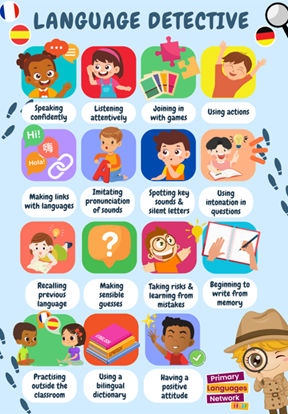
When we learn a foreign language, we are strengthening cognition by improving memory and concentration skills, building on creativity and problem-solving skills and developing empathy and social skills as a global citizen! You only have to glance at Primary Language Network’s 15 Language Detective skills to appreciate the transferable learning skills we are teaching in language lessons and how they develop the whole child.
Primary languages naturally lend themselves to inclusive methods of teaching. It is so disheartening, therefore when individuals and groups of children are routinely taken out of the classroom for catch-up groups when they have so much to gain from staying in. In fact, Bianka Zemke, HMI Lead for Languages, Ofsted backs this opinion up by saying that the biggest barrier to children with additional needs making progress in primary languages is them being removed for interventions. Of course, intervention groups are important, but schools may need to consider a timetable rota so the same children do not miss out each week.
So, what does adaptive teaching through the lens of primary languages look like?
What does adaptive teaching look like in practice?

The range of needs which may be identifiable in a class may or may not present themselves in the same way in the primary languages classroom. A lot is about educated trial and error and worth remembering that two children with the same SEND needs on paper may respond very differently to strategies. Things may work one day and not the next. Our mindset needs to be a ‘no-ceilings’ approach, where we expect all children to access the same learning but are scaffolded and supported along the way. And like the scaffolding on a building, as soon as it is no longer needed, it can be removed, piece by piece.
It starts with a safe culture for learning. Where every child feels welcomed and valued and where it’s ok to make mistakes. Maybe your lessons start and end in a familiar way each time; a greeting song in the target language for example. A ‘now’ and ‘next’ board may support children who like to know what to expect in a lesson and a working wall or knowledge organisers to promote self-efficacy.
The use of talk partners, group work and mini-whiteboards (see my previous blog post) are all opportunities for practice and rehearsal before formal speaking and writing occurs. Taking working memory into consideration by limiting the number of new words, using carefully chosen and consistent visuals and allowing writing to be seen as ‘sentence construction’ ordering flashcards can also lead to a more improved sense of confidence and competence.
The beauty is that whichever strategies you implement to support learners with additional needs in primary languages will no doubt benefit all learners in your classroom.
Putting it into practice with Primary Languages Network
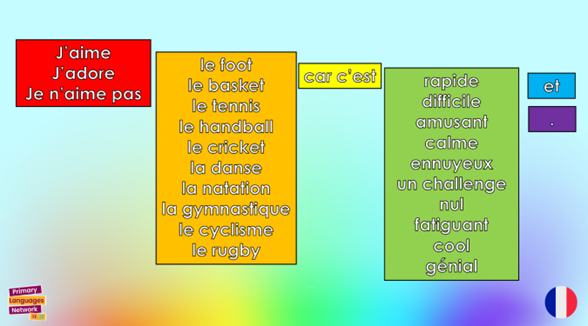
The Primary Languages Network schemes of work for French, Spanish and German have inclusion and adaptive teaching strategies built in, from recall warm-ups, or Go Fetch activities, to opportunities to practise writing at single word level right through to writing at extended sentence level. PLN’s unique Rainbow Writing scaffold can not only boost confidence but also success in writing as it supports the pupil to construct a grammatically accurate target language sentence independently.
For PLN members, there is a free professional development session on Adaptive Teaching and SEND which also includes tips on supporting EAL learners and those who need further challenge. It is available in both live and recorded formats, accessible via the Staff CPD Journey on your dashboard. During the session you will see numerous examples of how adaptive teaching can be implemented through using the PLN scheme in your classroom. The session ends with an informal case study activity giving you the opportunity to reflect on which adaptations you might make for a particular sequence of learning. Get in touch to find out more and access some of the support we have on offer.
Kate Percival, Primary MFL Consultant, Primary Languages Network