
How do mini-whiteboards boost confidence and learning in MFL?
Written by Kate Percival, MAT Lead and MFL Consultant, Primary Languages Network
What is it about mini whiteboards?
I don’t know about you, but to me, pupils seem more willing to write on a dry-wipe surface than they potentially do to write in their books. I wanted to find out why this was and how we can harness this motivation to put ‘marker to whiteboard’ in the primary languages classroom.
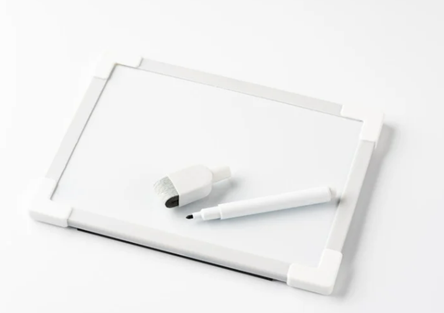
Drawing on Jamie Clark’s One Pageron mini whiteboards, @XpatEducatorjamieleeclark.com and other research, I have learnt that writing on a whiteboard activates both the visual and motor systems. Their surface is smooth and the pens seem to glide; this tactile nature appeals as a sensory experience. Whiteboards are also wonderfully low pressure (you can rub out and edit easily which is great for getting to grips with spellings and word order in a foreign language) and whatever is written isn’t going to be formally marked by the teacher. Pupils don’t need to copy the date or title before they begin writing (hooray!) and there are no lines to stick to. Handwriting can be as big as you like – the bigger the better in fact - we’ll come back to this later. Plus, there is a real sense of accomplishment at being able to fill the board with a few words or even a whole sentence in the target language.
I honestly haven’t taught a class who didn’t respond positively to whiteboard work (and that goes from Year 2 to Year 9 and includes some challenging groups too!). I’m now convinced that mini whiteboards are an essential tool in the languages classroom. In fact, at our Primary Languages Network conference Above and Beyond last year, a full set of whiteboards and pens was one of the first raffle prizes to be claimed!
So how can we make effective use of mini whiteboards as learning tools and the capitalise on the motivation that comes with using them?
· Active learning for all
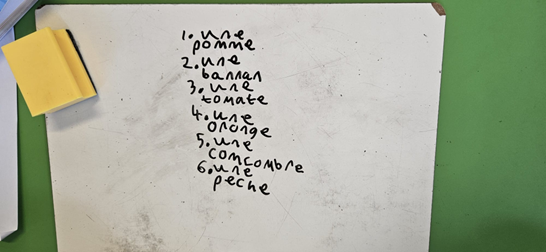
First of all, as long as they are ‘grabbable’, a huge benefit of mini whiteboard work is that they promote active learning. Everyone thinks. Everyone writes. This limits the opportunity to sit back and switch off. This opportunity to practise writing before more formal book work promotes memory and retention of spelling patterns and syntax (word order) as well as the opportunity to experiment and edit with sentence construction. Techniques such as time-limited overlearning (repeating a word or phrase over and over again for a short period e.g. a minute) focuses the mind and pupils often find they exceed their own expectations of how many times they are able to write a word or phrase. This sense of success really builds confidence.
· Formative assessment in action
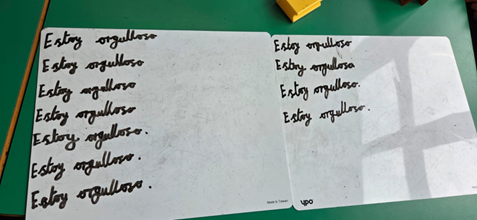
This sense of success is also apparent when you give the command to hold up their whiteboards. This is a great opportunity to use the target language ‘Un deux trois montrez-moi!’ and gives you the chance to do some real assessment for learning. Who has got it? Who hasn’t? Are there any misconceptions? Any gaps you may need to re-visit? What are the general trends? Instead of relying on hands up and assuming that everyone has understood based on one individual’s response, you can see, at a glance, a range of responses (hence the need for oversized handwriting) and at the same time you can select a child who you know has got a correct answer to read theirs out aloud. This then builds their confidence further to answer next time!
· Opportunity for practice
Of course, we can’t shy away from the fact that there is an expectation of formal writing in books to evidence the skill and demonstrate individual progress, but until then whiteboard work is such great practice that I have found when it comes to traditional pen-to-paper, pupils are much more confident to have a go.
The PLN schemes
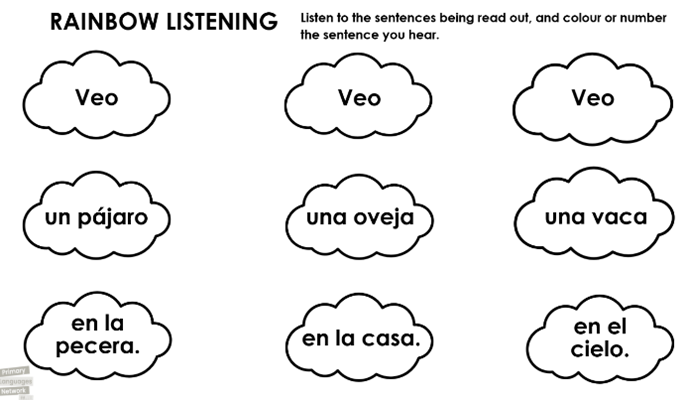
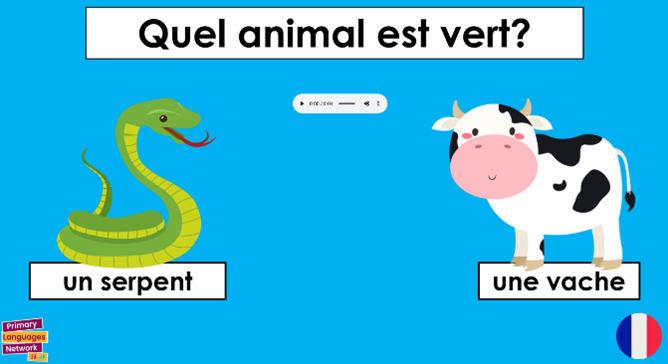
The Primary Languages Network schemes of work for French, Spanish and German have so many opportunities to use whiteboards within lessons, ranging from recallwarm-ups, or Go Fetch activities, to opportunities to practise writing at single word level right through to writing at extended sentence level. There is no need to prepare anything special to be able to make full use of whiteboards, just get into the habit of having them available to use and ‘Think: Whiteboard!’
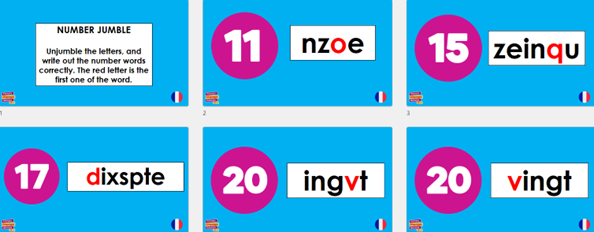
For PLN members, there is a free professional development session, in both live and recorded formats, accessible via the Staff CPD Journeyon your dashboard. During the session you will see numerous examples of how whiteboards can be used to complement the PLN scheme in your classroom.
Come and find out how to drive forward active engagement, boost confidence amongst your pupils whilst supporting you to formatively assess language learning progress. I look forward to seeing you at the next one!