
Every primary school we work with has at least one person who genuinely cares about languages.
A coordinator who stays late preparing resources. A headteacher who keeps languages on the timetable even when other subjects push for more time. A class teacher who goes the extra mile to make French or Spanish feel exciting for their class.
And yet, in most of those schools, languages is still fragile.
It still depends on that one person. It still gets cancelled when things get busy. It still lacks the consistency, the evidence and the visibility that would make it something the whole school is genuinely proud of.
The problem isn't enthusiasm. There's plenty of that. The problem is infrastructure.
Where This Method Comes From

Will Lloyd
I'm Will Lloyd, director of Primary Languages Network. And I want to be upfront about something: I'm not a language specialist.
I trained as a PE teacher. I learned Spanish later in life: as an adult, starting from scratch, figuring it out the same way the non-specialist teachers I now support have to every week.
That experience is the foundation of everything I've built.
Over the past decade I've delivered more than 1,000 CPD sessions, working directly with non-specialist teachers to help them deliver effective, consistent, high-quality language lessons. Not by turning them into linguists. By giving them a system that makes successful delivery achievable every single week.
I designed Video2Teach with those teachers in mind. I run countless sessions with languages coordinators, guiding them through the process of building provision from the ground up. I created the action planning approach that underpins Pillar 1 — the idea that strategic, multi-year improvement is possible for any school when the right structures are in place.
My mind is always on the non-specialist teacher.
What do they need?
What gets in their way?
What would make Monday morning feel achievable rather than daunting?
The Languages Momentum Method is my answer to those questions. It's tried, tested and built from 1,000 real conversations with real teachers in real schools.
My team are the language specialists — Kate, Emilie, Irene and Catherine each bring deep expertise in French, Spanish, curriculum design, CPD and coordination.
If you want to go deeper into any pillar, you can book a consultation and they'll work with you to design the right approach for your school.
But the method itself? That's built from a PE teacher who learned Spanish at 25 years of age and spent the next decade figuring out how to make languages work for everyone.
What We've Learned from 1,300 Schools
After working with over 1,300 primary schools across the UK, we've seen the same patterns repeat themselves again and again.
A coordinator inherits a neglected scheme and spends months trying to get teachers on board — only to find that the scheme itself doesn't guide delivery clearly enough for non-specialists to follow. More training gets arranged. Teachers nod along. Nothing changes on Monday morning.
A school picks a polished, branded scheme because it looks good in a brochure and seems defensible for Ofsted. It works for a term or two. Then it quietly falls apart in Year 4 when teachers realise it doesn't give them the structure they actually need in the classroom.
A passionate coordinator builds something bespoke — spending 100 hours creating a curriculum that reflects their expertise perfectly. Then they go on maternity leave. Or move schools. And everything they built goes with them.
These aren't failures of commitment. They're failures of system.
And the solution isn't to work harder, arrange more CPD or find a better scheme. The solution is to build the right infrastructure — in the right order.
That's what the Languages Momentum Method is designed to do.
The Languages Momentum Method
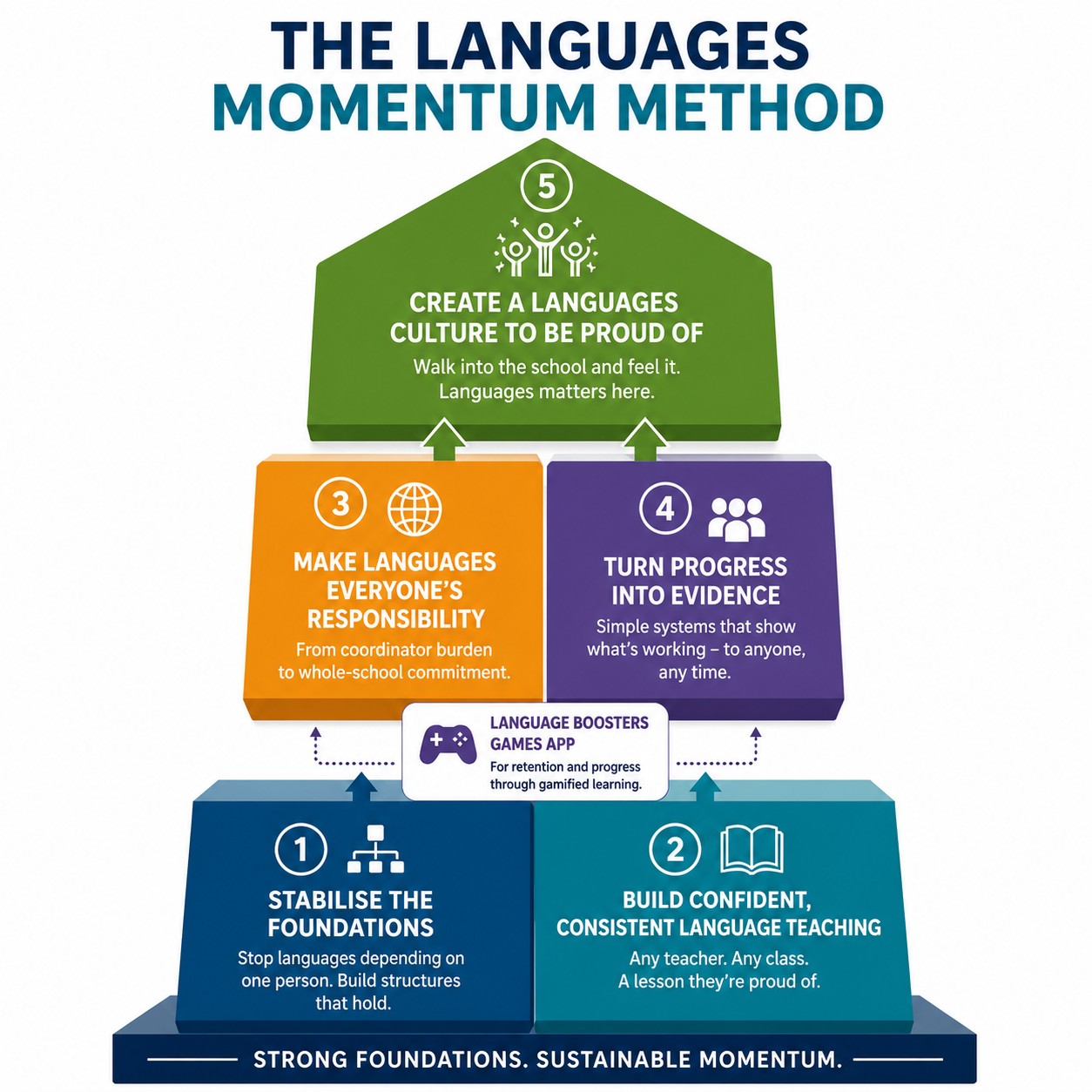
The Languages Momentum Method is a five-pillar framework for building primary languages provision that is sustainable, consistent, visible and something your whole school can be genuinely proud of.
It helps schools that are managing decline with primary languages, transform to create a solution which make thems proud of what they deliver
The sequence matters. Each pillar builds on the one before it. Skip a stage and progress becomes fragile. Follow the sequence and languages gains momentum — year after year.
Pillar 1 — Stabilise the Foundations
Stop languages from depending on one person. Build structures that hold.
Every successful languages programme begins with effective subject leadership. Not displays. Not enrichment. Not training days. Leadership first.
This means creating a clear action plan, auditing current provision honestly, building coordination systems that survive staff changes, and establishing monitoring structures that give SLT visibility without requiring the coordinator to report everything manually.
When the foundations are stable, languages no longer lives or dies based on one person's capacity. The system holds — even on the days when the coordinator is absent, overwhelmed or simply too busy to give languages their full attention.
Pillar 2 — Build Confident, Consistent Language Teaching
Any teacher. Any class. A lesson they're proud of.
Once leadership is secure, attention turns to what happens in classrooms.
The most common mistake here is assuming the solution is more CPD. In reality, teacher confidence begins with curriculum design. Without the right scheme and classroom support, even excellent training struggles to create lasting change. Teachers need a system that makes successful delivery achievable every week — whether or not they speak the language themselves.
This is what Video2Teach was designed for. I built it specifically for the non-specialist — the Year 4 teacher who hasn't spoken French since school, the class teacher who knows their pupils but doesn't know the language. The virtual native-speaker runs alongside them, modelling pronunciation, leading activities and managing the pace of the lesson. The teacher manages the class. The system handles the language.
Clear progression from word level in KS1 to full sentences and paragraphs by the end of KS2. Consistent lesson structure across every year group. Evidence that builds itself from good teaching rather than being assembled as a separate admin task.
Pillar 3 — Make Languages Everyone's Responsibility
From coordinator burden to whole-school commitment.
When leadership is strong and teaching is working, ownership can begin to spread.
This is the stage where languages stops being 'the coordinator's subject' and becomes a shared responsibility. Teachers contribute because they want to. SLT actively protect languages time because they can see the impact. Language Boosters — our interactive games app — gives pupils a way to practise vocabulary between lessons and at home, reinforcing classroom learning without adding workload for teachers.
When ownership is distributed, the subject becomes resilient. Languages survives not because one person is holding everything together — but because the whole school has a stake in it.
Pillar 4 — Turn Progress Into Evidence
Simple systems that show what's working — to anyone, any time.
Evidence should not be an additional workload. It should be the natural outcome of a well-led, well-taught subject.
When the first three pillars are in place, evidence begins to emerge automatically — from workbooks, assessment records, Language Boosters data, pupil progress sheets and monitoring tools. The coordinator always knows where the subject is, where it has been and where it is heading. And they can show anyone who asks without scrambling to prepare.
This is often the stage where schools move from secure provision to genuine excellence.
Pillar 5 — Create a Language Culture to Be Proud Of
Walk into the school and feel it. Language matters here.
This is the destination.
Language is no longer an isolated 30-minute lesson. It has become part of the school's identity. You see it in classrooms. You hear it in corridors. You notice it in how pupils talk about their learning.
Pupils enjoy languages. Teachers enjoy delivering it. Displays are visible and purposeful. Cultural events are embedded in the school calendar. Transition to secondary school is strong because pupils arrive in Year 7 with real foundations.
Most importantly, the provision no longer depends on any one person. The system continues to move forward because momentum has been built.
Why the Sequence Matters
It's tempting to jump straight to Pillar 5. Schools want the displays, the celebrations, the culture. They want languages to feel exciting and valued.
Culture without foundations is decoration. It looks good for a term and then fades.
Without the coordination infrastructure of Pillar 1, a languages culture collapses the moment it loses its champion. Without the consistent teaching quality of Pillar 2, there's nothing meaningful to celebrate.
The sequence is not a suggestion. It's the difference between a languages programme that builds momentum and one that keeps starting over.
Start where you are. Work through the pillars in order. And watch languages become something your whole school is genuinely proud of.
Where to Start
If you're a languages coordinator reading this, the most useful thing you can do right now is an honest audit of where your school sits across the five pillars.
Which foundations are secure? Where is teaching consistent? How much ownership sits with you alone? What evidence exists? What does the culture feel like to a visitor walking into your school for the first time?
That picture — however uncomfortable it is to look at, honestly — is your starting point.
And the good news is that significant progress is achievable within a single term when you have the right framework in place.
If you'd like to talk through where your school sits, book a consultation with Kate or one of the team. They'll design the right approach for your context.
Start your free 4-week trial - full access to all five pillars from day one.
Primary Languages Network works with over 1,300 primary schools across the UK, providing French, Spanish and German schemes of work, CPD, workbooks and the Languages Momentum Method framework for building sustainable primary languages provision.