

Kate is the MAT lead at Primary Languages Network
Number 3 of A series of blog posts outlining a five-point strategy for Managing Effective Primary Languages for Multi-Academy Trusts & trust wide success
Written by Kate Percival
Blog #1 In It Together: Collaboration and Primary Languages in MATs (1/5)
Blog #2 What does support for primary languages look like on a trust-wide scale? (2/5)
National guidance
According to the DfE KS2 Programme of Study for languages, pupils have four years during KS2 to make ‘substantial progress in one language’. There should be an ‘appropriate balance of spoken and written language’ and it should ‘lay foundations for further foreign language teaching at Key Stage 3’.
According to Ofsted, the inspectorate requires pupils to make progress in all four skills or ‘modalities’ of language learning: listening, speaking, reading and writing. And this progress should be made via the three ‘pillars of progression’ namely vocabulary, grammar and phonics’ with intercultural understanding and empathy woven throughout.
Although schools are not formally required to assess in languages, it makes sense and is good practice for subject leaders to implement a system of tracking and assessing progress which works within the specific context of their school.
Yet many Multi-Academy Trust and cluster language leads share a similar challenge: to support their family of schools consistently with tracking and assessment systems whilst being mindful of workload and allowing individual schools flexibility.
Here are some things to consider:
Shared vision
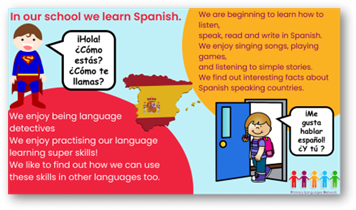
What is your shared vision for primary languages across your trust? After all, progress in a subject follows when both staff delivering and pupils learning feel passion for the subject and feel comfortable and confident teaching and learning it. Ensure your scheme of work is ambitious yet supportive, of both the children and the teachers in the classroom. Agree on what skills, content (vocabulary, grammar and phonics) and cultural understanding you want to build in to your curriculum and therefore what you want to track the progress of.
A summary of progress
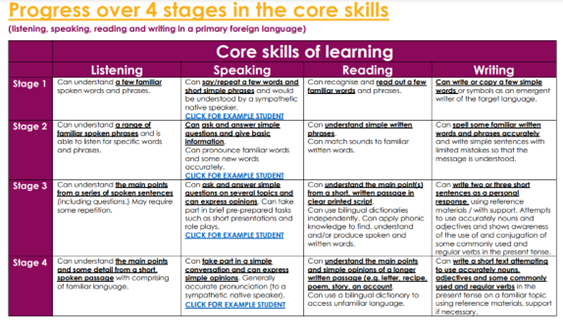
An example of our core skills progress sheet
Every member of staff should be aware of what progress looks like throughout the four compulsory years of language learning at KS2. However, the twelve DfE attainment targets are designed as end points and are not broken down into stages. At PLN, we have developed a Core Skills Progress chart which outlines expectations for the average learner in each stage across the four skills and also includes video examples for the speaking strand.
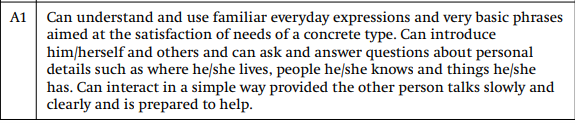
An assessment level
Assessment levels are based on four stages of progress towards the CEFR (Common European Framework of Reference) for languages A1 level by the end of KS2. This is an internationally recognised measurement of competency.
PLN runs an online twilight session called ‘Understanding Progress’ where these expectations are exemplified and attendees can see how to evidence each one effectively as part of the learning process (e.g. not seeing evidencing or assessment as a bolt-on). We also summarise the progress journey in four easy phrases – easy to remember and easy to have in the back of your mind when teaching a particular stage of learning. Once everyone is clear what ‘substantial progress’ looks like at their school, it becomes much easier to aim for.
Across a trust of schools, it is helpful if consistent terminology is used (e.g. Emerging, Meeting and Exceeding or Working Towards, ARE and Greater Depth) and even more streamlined if every school uses a similar tracking and assessment system so that when opportunities arise for MFL coordinators across a trust to come together, they are focusing on the same priorities and can therefore support each other through their shared experience. So, what are the choices?
Teacher Assessment
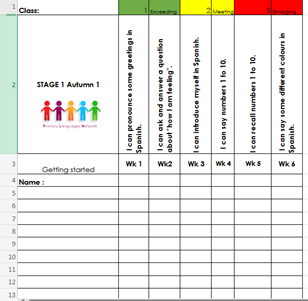
an example teacher assessment sheet
Once teachers are secure in their understanding of progress, they will feel confident formatively assessing on the go in every lesson they teach. In fact, in our introductory whole-school sessions to the PLN scheme, we train all teachers to do just this. The kinds of games and activities built into the PLN scheme allow teachers to gauge understanding and progress made across a unit. This individual knowledge of the children accompanied by evidence of the four skills (written work, recordings etc) bolster a teacher’s judgement to be able to provide an outcome by the end of the unit. How do your teachers track coverage and progress? Do they have any documentation which is simple and straightforward to complete which builds up a picture over time?
Self and peer assessment
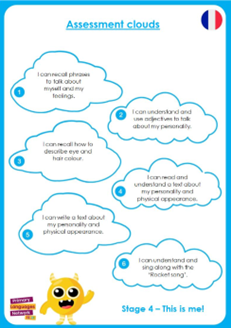
Tracking clouds self/peer assessment sheet
Self-assessment should be encouraged as it promotes metacognition and is a great indicator of confidence. For older children they may wish to use self-assessment documents to annotate with words and phrases they remember. Although not to be relied on solely this can support teacher assessment. Do you have a self-assessment system which is pupil-friendly and promotes reflection of learning?
Summative assessment
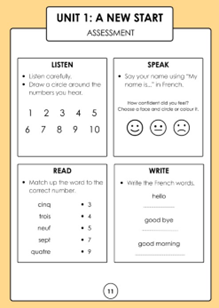
an example puzzle-it-out sheet
Do you have a child-friendly summative assessment in place to evidence end of topic progress? Again, not to be relied on solely, but summative assessments can be extremely useful to gauge individual competencies especially for those children deemed ‘borderline’ in teacher assessment. PLN’s ‘Puzzle It Out’ assessments are designed to be used optionally at the end of a topic and within one lesson allowing flexibility over which skills teachers focus on to assess and which assessments to use throughout the year. Each assessment comes with a teacher guide, including audio files for the listening activities plus a pupil worksheet.
How does your MAT measure up?
We've built a free audit tool so you can assess language provision across your trust in under 20 minutes — with built-in RAG scoring, a trust-wide dashboard, and benchmarks built in.
In summary, when every school in a trust agrees on and follows the same structured progression model and is supported to understand what progress in primary languages looks like, pupil progress becomes much more streamlined and is easier to track and evaluate. Using a consistent scheme can ensure progression is clearly mapped from Years 3 to 6 and can embed similar expectations across schools. These agreed progression pathways drive standards forwards across the trust. When schools align their approach to tracking and assessment they build a shared culture where teachers are supported, pupils progress is visible and languages are valued.
At PLN we have a professional development journey for out MAT members (which include Astrea Academy Trust, Co-op Academies and Cambrian Learning Trust) to supports aspects of teaching and learning, subject leadership, tracking and assessment, pupil progress and moderation allowing you to oversee trust-wide progress effectively.
Kate Percival, MAT Lead and MFL Consultant, Primary Languages Network